
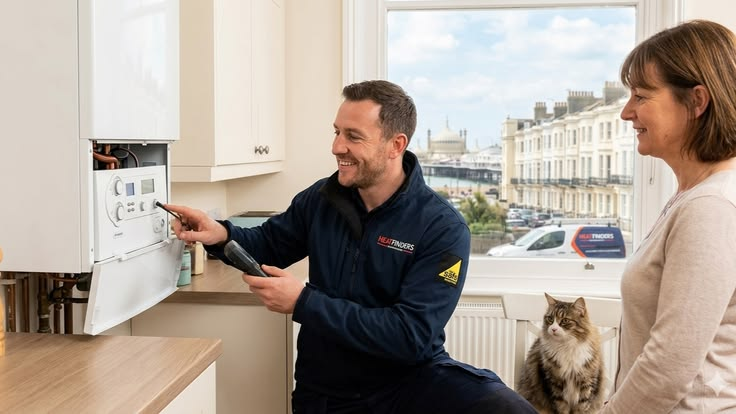
The van arrives at half past seven. Dust sheets go down, the water comes off, and by the time most households have finished breakfast the old appliance is already draining. A boiler installation is a one-day job in the ordinary case, and whether it stays one day was decided weeks earlier, when somebody either did or did not come and look properly at the house. Households comparing a boiler installation cost tend to read the totals and skip the survey notes, which is where the difference between a smooth day and an expensive one usually sits.
Follow the day forward and the decisions announce themselves in order.
What a boiler installation service settles before the van arrives
The survey is the part of a boiler installation service that no one photographs and everyone relies on. It fixes where the appliance goes, how the gas supply and pipework reach it, where the condensate discharges, and what happens to the flue. Each of those answers turns into an hour saved or lost on the day.
Flue termination is the constraint that catches households out most often. It has to meet the manufacturer’s clearances from windows, doors and boundaries, and those clearances are frequently what dictates where a replacement can go at all. A boiler cannot simply stay where the last one was because that is where the pipes are, and a survey that has not measured those distances has not finished.
Condensate is the quieter version of the same problem. It has to reach a drain, it has to fall the whole way, and an external run that freezes in January is the most common winter call-out on an otherwise sound appliance. Where the discharge goes should be written on the survey rather than decided by whoever is holding the pipe at four in the afternoon.
The other item to settle beforehand is the engineer. Work on a gas boiler must be carried out by a Gas Safe registered engineer, and the registration card carries the appliance types that engineer is qualified for. Asking to see it is normal, and the card is meant to be shown.
Confirm both before the date is booked rather than in the morning.
Isolation, removal and the installation of boiler and flue
The first hour of the installation of boiler work is undramatic and almost entirely about isolation. Gas off at the meter, water off, the system drained down, and the electrical supply proved dead before anything is disconnected. Removal follows, and an old appliance normally comes off the wall faster than anything goes back on it.
Then the day slows, because the new work begins.
Pipework is where a survey either pays for itself or does not. A like for like replacement in the same position with the same pipe positions is quick. A move to another wall means running gas, flow, return and condensate to a new position, often through joists or behind units, and that is half a day on its own. Gas pipe sizing matters here too, because an older supply sized for a previous appliance may not carry what the replacement needs. The flue goes in against the manufacturer’s clearances measured at survey, and where a route through a wall or roof needs forming, that is the part of the day most likely to overrun. Everything after this point depends on the pipework being right, which is why an unhurried middle of the day is a good sign rather than a worrying one.
This is also the stage where a household hears the only real surprises. Corroded pipe behind a kitchen unit, a gas run that has to be upgraded, an airing cupboard that will not take the new unit without a shelf coming out. A company that surveyed properly raised these as possibilities weeks ago, and the conversation is short.
Where boiler installation services prove their quality
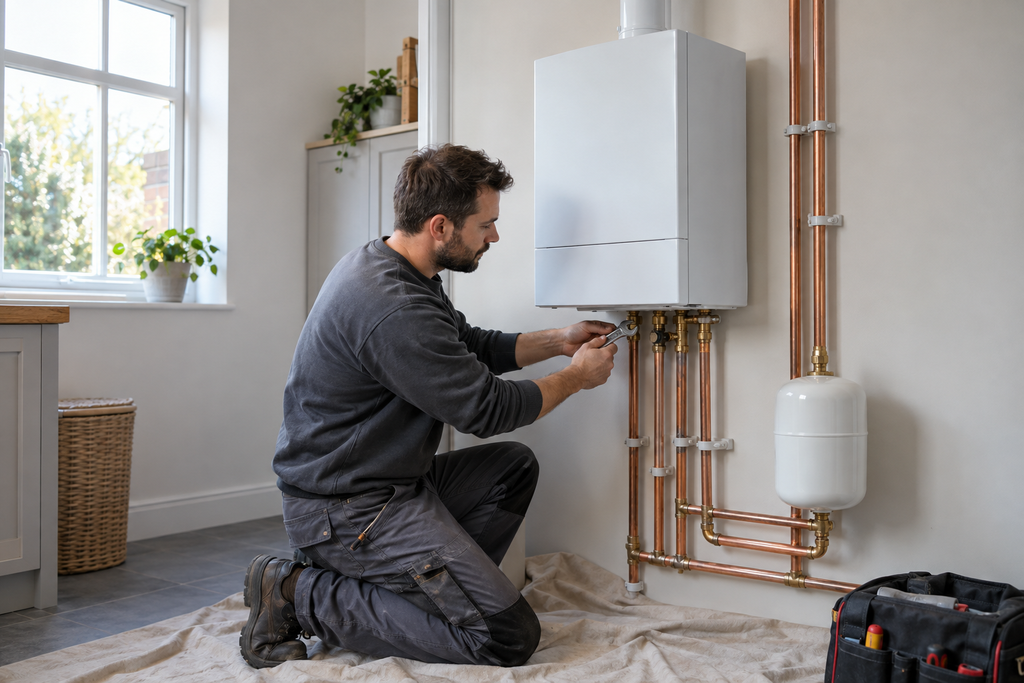
By early afternoon the appliance is on the wall and connected, and the part that separates careful boiler installation services from quick ones begins. The system is cleaned before the new appliance is asked to heat it, a magnetic filter is fitted so that what remains in the radiators is caught rather than circulated, and inhibitor goes in to slow the process starting again.
Skipping this stage saves two hours and costs the appliance years. Debris from old pipework ends up in the heat exchanger and in the pump of a new boiler, and that damage is rarely covered by anyone.
Commissioning is the last technical act of the day.
- The system is flushed and dosed, with the filter fitted where it can actually be serviced rather than behind a cupboard panel.
- Gas rate and burner pressure are checked against the manufacturer’s figures, with a flue gas analysis recorded rather than estimated.
- Controls are set up and explained, including the flow temperature the system will run at day to day.
- The installation is tested in the state the household will use it, hot water and heating both, before anyone packs up.
None of it is visible once the covers are back on, which is exactly why it is written down.
Paperwork good boiler installation companies hand over
The job is not finished when the heating comes on. It is finished when three documents exist, and the difference between boiler installation companies is often visible in how quickly those documents arrive.
- The engineer’s Gas Safe registration details, with the work recorded against them.
- The Building Regulations compliance certificate, since the installation is notified through the registration scheme and the certificate follows to the householder.
- The Benchmark commissioning checklist, completed and signed at handover, which manufacturers generally require before a warranty is valid.
A householder who has all three has a warranty that will be met, a compliant installation on record for any future sale, and a baseline for the first annual service. A householder missing one of them usually discovers it years later, at the worst possible moment.
Ask for the pack on the day. It closes the job properly, and it is the only part of the work that will still be readable in ten years.