
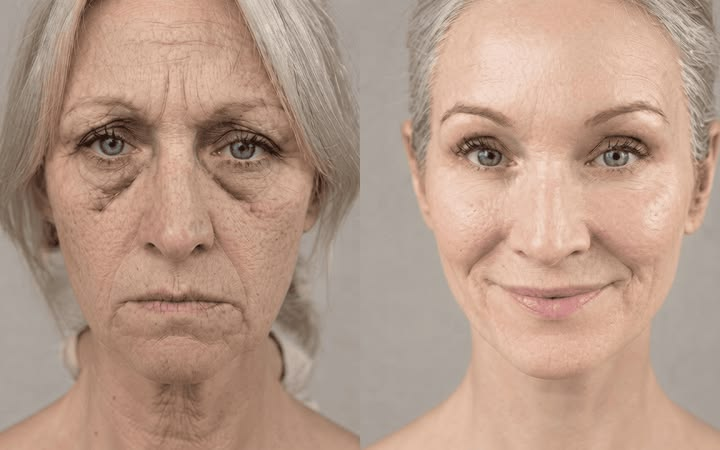
Facial structure changes dramatically as decades pass. By the time someone reaches their fifties or sixties, the underlying architecture of the face has shifted in ways that surface level skincare simply cannot address. Collagen production drops significantly; elastosis sets in, and fat pads begin to shrink and descend. At the same time, bone resorption and facial aging alter the underlying foundation, particularly around the orbits, jawline, and midface. Addressing these multi-layered changes requires a clear strategy rooted in rheology, particle size, and tissue mechanics.
The Physiology of Mature Skin and Deep Structural Changes
Aging skin behaves quite differently than younger tissue. Decades of cumulative ultraviolet exposure and hormonal shifts reduce epidermal thickness and compromise the dermal matrix. Skin laxity and thinning leave the surface fragile, meaning any material injected beneath it behaves with less natural cushioning from the skin itself. When soft tissue thinning meets deep structural volume loss, the visual impact is compounded.
Resorption of the facial skeleton reduces the projection of the maxilla and chin. As the bony support recedes, the overlying deep fat compartments lose their anchor points. This leads to the characteristic sagging of the midface, formation of deep nasolabial folds, and jowl development along the mandibular border. Selecting dermal fillers for aging skin means accounting for both the loss of structural scaffold at the periosteal level and the thinning of superficial soft tissue layers.
To address these complex anatomical shifts, practitioners often turn to specialized cross-linked hyaluronic acid gels. Stylage is a versatile range of cross-linked hyaluronic acid dermal fillers designed with incorporated antioxidants, such as mannitol, to reduce swelling and slow down gel degradation in the tissue. Aesthetic professionals utilize Stylage to restore volume, correct deep wrinkles, and recontour facial features affected by age-related volume loss. Clinics and licensed practitioners often purchase wholesale Stylage for aesthetic clinics through medical supply platforms to maintain adequate stock for comprehensive facial treatments. Stylage formulations vary in HA concentration and viscosity, allowing injectors to customize their approach based on whether they are targeting deep periosteal loss or superficial fine lines.
Monophasic Fillers: Homogeneity and Tissue Integration
Monophasic gels are manufactured as a single, continuous phase of cross-linked hyaluronic acid. During production, the cross-linking process creates a uniform gel network without discrete particles. Monophasic gel homogeneity gives these materials predictable extrusion forces and smooth flow characteristics during injection.
Because the gel is cohesive and uniform, it spreads evenly into local tissue spaces. In mature skin facial rejuvenation, this quality makes monophasic fillers useful for superficial to mid-dermal applications. When injecting areas with fine wrinkles or thinner tissue cover, a cohesive monophasic gel integrates smoothly without forming visible or palpable nodules under fragile skin.
- Monophasic gels provide high cohesivity, holding their structure together as a single unit under shear stress.
- Bi-phasic gels consist of cross-linked HA particles suspended in a non-cross-linked HA carrier gel, offering strong lifting capacity.
Hydrodynamic stability is another factor here. Monophasic gels tend to absorb water evenly, swelling in a controlled fashion. For older patients whose skin lacks elasticity, excessive or unpredictable swelling can distort delicate facial contours. A 2019 clinical review examining HA rheology noted that uniform cross-linking correlates directly with lower post-injection tissue disruption in thin dermis. Predictable hydration dynamics help ensure natural-looking results for older patients.
Bi-Phasic Fillers: Particle Size and Lifting Capacity
Bi-phasic fillers take a different structural approach. These materials consist of cross-linked hyaluronic acid particles suspended within a non-cross-linked HA carrier fluid. The carrier fluid facilitates smooth passage through the needle; once placed in the tissue, it absorbs rapidly, leaving the dense cross-linked particles behind.
This particle-based design changes how the gel interacts with mechanical stress. Biphasic particle-based gels typically exhibit high elastic modulus, or G prime. A high G prime means the material resists deformation when subjected to pressure from overlying tissue or muscular movement.
In patients in their 50s and 60s, deep structural volume loss requires significant projection force. A bi-phasic filler placed along the periosteum acts as a solid bolster, physically pushing up sagging deep fat pads and restoring lost bony prominence. The distinct particle sizes within different bi-phasic lines allow practitioners to select specific cross-linking densities tailored to the depth of the targeted deficit. Stylage also offers specific high-viscosity formulations engineered for deep structural restoration, matching this demand for firm support.
Rheology Matches Anatomy: Comparing the Two Phases
Deciding between monophasic vs. biphasic dermal fillers comes down to a comparison of tissue mechanics, rheological properties, and depth of placement. Neither structure is inherently superior; rather, each serves a specific mechanical purpose within the aging facial framework.
Monophasic gels excel in areas requiring high cohesivity and smooth tissue blend, such as perioral lines or delicate tear trough areas where particle visibility would be a risk. Bi-phasic gels excel when pure vertical lift is required against heavy, sagging tissue layers.
The structural behavior of these gels determines how they hold space under mechanical compression. Monophasic options distribute lateral shear stress evenly, making them stable in dynamic facial zones. Bi-phasic options concentrate vertical projection, making them effective where bone has receded.
Strategic Layering and Placement Techniques
Achieving natural restoration in older patients rarely involves relying on a single gel type. Instead, expert injectors utilize a multi-layer injection technique that matches filler rheology to anatomical depth.
Deep vs. superficial placement by age requires careful planning. Deep placement along the bone needs high-G-prime materials to replace lost skeletal volume and provide structural support. Superficial placement, meant to smooth fine surface crinkling or restore subcutaneous softness, requires low-viscosity, highly cohesive monophasic gels that blend without creating lumps.
Thorough consultation and facial assessment form the foundation of this strategy. Practitioners evaluate dynamic muscular movement, skin thickness, degree of elastosis, and specific bone loss patterns before selecting products. Combination treatment planning might incorporate a firm, structural gel like Stylage XL at the zygomatic arch and a softer, flexible formulation within the dynamic midface area.
Longevity in mature skin depends heavily on local metabolic activity, vascularity, and the degree of cross-linking within the chosen gel. Deeper placements along the periosteum generally degrade slower than superficial placements due to less mechanical movement and lower enzymatic activity in deep planes. Using the correct phase structure at the correct anatomical layer optimizes both immediate lifting performance and overall duration of effect.